
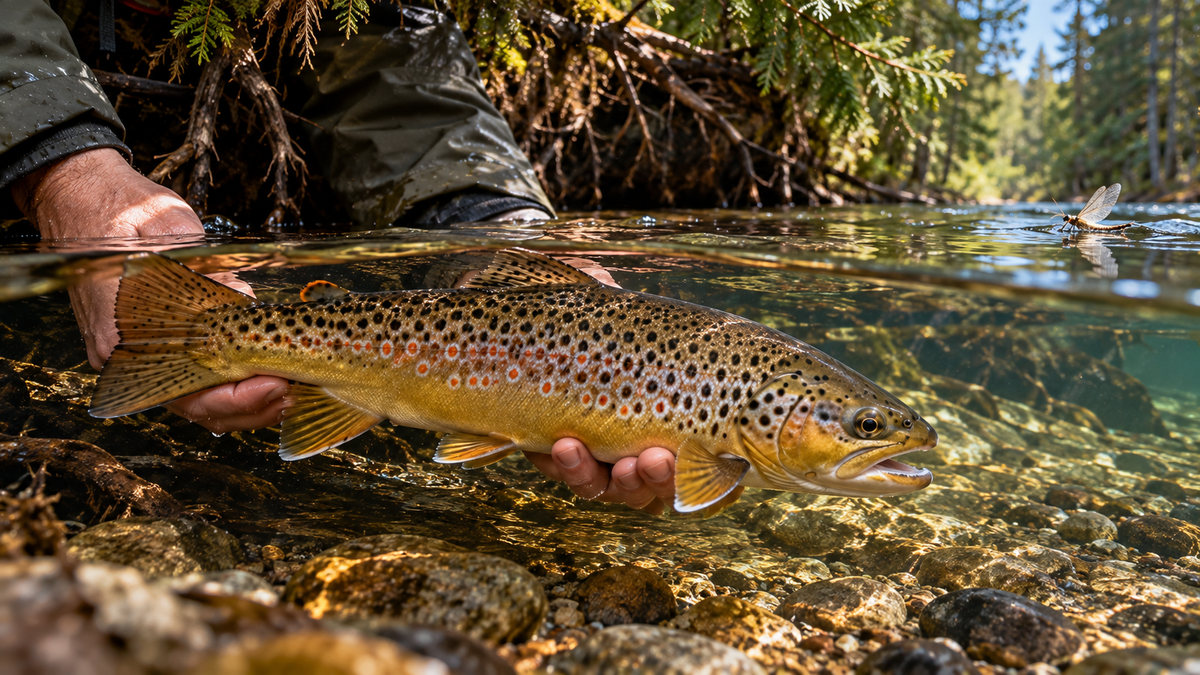
Michigan brown trout fishing is easier to understand once you stop treating every brown trout in the state like the same fishing problem.
Michigan has resident browns living in coldwater rivers and streams. It has brown trout in inland lakes. It also has Great Lakes browns that can look and behave very differently from the fish holding beneath a logjam in a trout stream. Same species. Different fishery.
So before asking which fly, lure or bait to use, start here:


A Michigan brown trout sitting beside woody cover on the Au Sable is not the same fishing problem as a lake-run brown cruising nearshore water in early spring. Figure out which fishery you’re actually fishing first.
At a Glance
Michigan Brown Trout at a Glance
Michigan brown trout are one species living in several different fisheries. That distinction should control how you plan the trip.
Native Status
Are Brown Trout Native to Michigan?
No. Brown trout, Salmo trutta, are native to Europe and parts of Asia. Michigan DNR says brown trout were introduced to Michigan in 1883, making Michigan one of the first states to import the species into North America. They subsequently became established and are now an important part of the state’s trout fishery. That history matters because brown trout should not be confused with Michigan’s native brook trout.
This article has a narrower job than a full species profile: where do brown trout fit into Michigan fishing, and how should anglers approach those different fisheries?
Where to Find Them
Where Are Brown Trout Found in Michigan?
There isn’t one useful answer such as “northern Michigan.” Michigan DNR describes brown trout as thriving statewide, from famous northern trout rivers to smaller marginal trout streams in southern Michigan. But statewide distribution does not mean every brown trout fishery should be approached identically. For fishing purposes, divide Michigan brown trout into three broad situations.
01. Rivers & Streams
The classic Michigan brown trout fishery. Fish browns around current seams, pools, undercut banks, woody cover, depth changes, feeding lanes and riffle-run transitions. The exact habitat changes from river to river — the water should determine the tactic, not the species name alone.
current + cover + depth + food
02. Inland Lakes
DNR also identifies brown trout opportunities in inland lakes. These fish create a different location problem — anglers are no longer simply reading current. Depth, temperature, shoreline structure, forage and seasonal movement become increasingly important.
season + depth + structure + forage
03. Great Lakes
Lake-run adults can look substantially more silver than resident stream fish. DNR notes early spring can produce important Great Lakes brown trout opportunities from shore, piers and boats. This is a separate fishery, not just “river fishing with more water.”
season + water zone + forage + presentation
Rivers
Best Brown Trout Rivers in Michigan
Au Sable River
The Au Sable River is one of Michigan’s best-known trout systems, and DNR identifies brown trout throughout portions of the watershed. Its importance isn’t simply that brown trout live there — the Au Sable demonstrates how Michigan brown trout fishing revolves around the interaction of current, cover, aquatic insects, changing light, presentation and angling pressure. Depending on the reach and season, an angler may be solving a hatch problem, a subsurface presentation problem or a larger-forage problem. That’s why “best fly for the Au Sable” is usually a weaker question than: what are the fish doing in this section of the river right now?
Manistee River
DNR also identifies the Manistee River as an important brown trout fishery. It reinforces another point: river scale matters. Larger water changes how anglers identify productive features, cover water and control presentations. Don’t look at a broad river as one piece of habitat — find seams, depth changes, cover, current transitions, pool structure and feeding lanes within it.
Pere Marquette River
The Pere Marquette River is another Michigan river specifically identified by DNR for its brown trout fishery. Like the Au Sable and Manistee, it deserves its own Water intelligence rather than having its fishing guide duplicated here. The lesson: Michigan’s famous brown trout rivers are not interchangeable, and a tactic that works on one piece of one river does not become a statewide formula.
Smaller Michigan Trout Streams
Some of the most useful brown trout water in Michigan isn’t attached to a nationally famous river name. DNR notes brown trout occur from well-known trophy waters to smaller marginal trout streams in southern Michigan. On smaller water, approach can become more important, holding lies can be compressed, cover may dominate fish position, and short accurate presentations may matter more than distance. Don’t assume a river has to be famous to hold brown trout worth fishing.
Michigan Brown Trout in Inland Lakes
Current DNR Better Fishing Waters data identifies brown trout opportunities in inland waters including Bear Lake in Kalkaska County, Guernsey Lake, Starvation Lake, Clam Lake in Antrim County, Lake Charlevoix, Lime Lake in Leelanau County and Stony Lake in Oceana County. These examples aren’t exhaustive, but they demonstrate that Michigan brown trout are not exclusively stream fish. Without river current to organize the water for you, consider seasonal water temperature, available depth, shoreline structure, forage location, low-light periods and areas where suitable temperature and food overlap. Methods can include trolling, bait fishing and artificial lures where legal. Check current regulations before targeting any inland lake.
Great Lakes
Lake Michigan Brown Trout and Great Lakes Browns
Great Lakes brown trout deserve to be treated separately from Michigan’s resident stream fish. DNR notes brown trout can provide strong Great Lakes fishing during early spring, often before some other fisheries become active. Anglers may encounter them from shore, from piers, while wading, or by trolling nearshore water. Lake-run browns can also look different — predominantly silver, with body spotting sometimes less obvious than on resident stream fish.
Cold spring water can keep Great Lakes brown trout within reach of nearshore anglers. The fishing problem becomes: where do suitable temperature, forage and fish movement overlap? That’s fundamentally different from standing beside a river and asking which seam a brown trout is using.
Trolling allows anglers to search water and present plugs, imitation minnows and other legal offerings through productive zones — but trolling isn’t an excuse to ignore fish location. Before changing lure colors every ten minutes, consider whether you’re fishing the correct depth, water zone, speed, structure and forage area. Solve location before obsessing over the offering. Shore and pier fishing can also become accessible without a boat where local conditions, access and fish movement put fish within reach — always verify current access and regulations rather than relying on an old fishing report.
By Season
How Michigan Brown Trout Fishing Changes Through the Year
Spring
In rivers, anglers may encounter changing flows, cold water and increasing aquatic insect activity. In the Great Lakes, cold nearshore conditions can create important brown trout opportunities from boats, piers and shore. Don’t automatically assume a spring trout must be feeding on the surface because insects are beginning to appear — observe first.
Summer
Water temperature, light and available cover can become increasingly important in rivers. Hatches can create periods of concentrated feeding, and terrestrial insects can contribute to trout diets during warmer months. Larger browns may increasingly exploit larger prey where available. A trout rising during a hatch and a large fish holding tight to cover are not asking you to solve the same presentation problem.
Fall
Brown trout spawn in fall. DNR describes spawning movement occurring in tributary streams during September and October, with fish selecting shallow gravelly or rocky areas for redd construction.
Important
Do not deliberately fish over actively spawning brown trout on redds — instead identify legitimate non-spawning holding and feeding water. Fall can also change the behavior and location of Great Lakes browns as fish approach tributary environments.
Winter
Some Michigan waters provide legal brown trout fishing opportunities during winter, but season and possession rules depend on the water classification and current regulations. For river anglers, this generally increases the importance of finding efficient holding water, controlling depth, slowing down and thoroughly covering productive areas.
Method
How to Catch Brown Trout in Michigan
The right method depends on the fishery.
Fly Fishing
Fly fishing is deeply connected to Michigan’s river brown trout tradition, but it still includes several different presentation problems. Dry flies work when brown trout are actively feeding at the surface — watch the water first: are trout rising, where, on the surface or just below, and what size and profile are the naturals? A correct fly dragging unnaturally through the feeding lane can still be the wrong presentation. Nymphs put aquatic-insect imitations into productive subsurface water — solve the problem in order: position → depth → drift → fly. Streamers represent larger moving prey; look at cover, depth, current edges, low-light conditions, water clarity and likely ambush positions. Don’t fish a streamer merely because somebody said big browns eat streamers — fish it because the water and fish behavior make it logical.
Spinning and Conventional Tackle
Michigan brown trout are not reserved for fly anglers. DNR specifically identifies spinners, artificial minnows, bait and other conventional approaches as legitimate brown trout methods where regulations allow them. Spinning tackle can be particularly useful to cover water, fish moving lures, reach deeper water, work around structure and imitate baitfish or other larger prey. Find the fish first.
Trolling
Trolling becomes particularly relevant in inland lakes and Great Lakes brown trout fisheries, helping anglers search larger areas and control presentations through selected depths and water zones. Trolling is a location system before it’s a lure-color contest.
Hex Fishing
Michigan’s Hex Fishing and Big Brown Trout
One of Michigan’s best-known brown trout fishing events is the emergence of the giant Michigan mayfly, Hexagenia limbata, commonly called the Hex. DNR specifically notes that fly anglers pursue brown trout after dark during notable insect hatches, especially the Hex. A major food event can change when and where brown trout feed — fish difficult to encounter during daylight may become active during low-light or nighttime feeding opportunities.
But Hex fishing is still not “tie on a Hex fly, catch giant brown trout.” You still have to solve whether the hatch is actually occurring, which stage trout are eating, where fish are feeding, whether your presentation matches the naturals, and whether you’re fishing safely after dark.
What do Michigan brown trout eat? DNR lists adult brown trout foods including insects and larvae, crustaceans, mollusks, amphibians, small rodents and other fish — two broad presentation worlds: invertebrate/hatch feeding and larger forage/predatory feeding. Neither is automatically “better”: the fish’s current feeding opportunity determines which one matters.
Eddy Says
Brown trout get all the magazine covers because one of them eats a mouse at midnight and suddenly he’s a celebrity. Respectable fish, sure. Still European.
Regulations
Michigan Brown Trout Fishing Regulations
Do not use this article as your legal authority. Michigan brown trout regulations vary by water. Inland trout waters can be classified under different stream and lake Types, and those classifications affect fishing season, possession season, minimum size, possession limits and tackle rules. Special-regulation waters can add another layer.
Great Lakes brown trout fall under Michigan’s Great Lakes trout and salmon regulations rather than simply inheriting the inland-trout rules. Under the broad 2026 framework, Lake Superior, Lake Michigan, Lake Erie, Lake Huron and specified connecting waters are open all year, but anglers still need to check current size, possession and any water-specific rules.
Before fishing, use the current Michigan DNR Fishing Regulations. For inland trout waters, also use Michigan DNR’s Inland Trout and Salmon Regulations Map. If you need the season framework first, see Michigan Trout Season. A regulation telling you that fishing is legal does not grant access across private land — verify access separately.
Brown Trout Festival
What Is the Michigan Brown Trout Festival?
The Michigan Brown Trout Festival is a long-running fishing tournament and community event held in Alpena. The festival’s official site describes it as the longest-running fishing tournament in the Great Lakes. The 52nd annual Michigan Brown Trout Festival was held July 17–26, 2026, with its Super Tournament scheduled for July 25–26.
That satisfies an important distinction: if you’re looking for the Michigan Brown Trout Festival in Alpena, you are looking for an event. If you’re looking for Michigan brown trout fishing, you’re looking for the fishery described in this guide. Related subjects — not the same search problem. Because event dates, tournament rules and schedules change, use the official Michigan Brown Trout Festival website for current event information rather than relying on an evergreen guide.
Decision Framework
Michigan Brown Trout Decision Framework
When you arrive at the water, use this sequence.
1. Identify the Fishery
Stream → inland lake → Great Lakes. That determines the rest of the problem.
2. Identify the Seasonal Situation
Water temperature trend, flow, light, insect activity, forage, spawning behavior, seasonal movement.
3. Predict Fish Position
Rivers: current + depth + cover + feeding access. Lakes: depth + temperature + structure + forage. Great Lakes: season + productive water zone + forage + movement.
4. Identify the Food Opportunity
Aquatic insects, terrestrials, baitfish, or other larger forage — don’t decide what they “should” eat before observing what’s available.
5. Choose the Presentation
Dry fly, nymph, streamer, spinner, artificial minnow, bait where legal, trolling presentation, or another legal method suited to the fishery.
6. Troubleshoot the Right Variable
If you’re not catching fish: fishery → position → depth / water zone → presentation → offering. The lure is near the end of the sequence for a reason.
Michigan brown trout fishing isn’t compelling because the state has one famous river or one famous hatch. It’s compelling because brown trout occupy several distinct fishing systems within the same state. Learn the fishery. Read the conditions. Find the fish. Then choose the presentation.
