
Body Color
Depending on the population, Cutthroat Trout may appear: olive, golden, bronze, yellowish, gray or relatively silvery. Resident mountain-stream fish can look very different from larger lake-dwelling or coastal forms.

Common Name: Cutthroat Trout
Scientific Name: Oncorhynchus clarkii
The feature that gave the Cutthroat Trout its name is also the first place most anglers look: a red, orange or crimson slash beneath the lower jaw. Those markings can be vivid or surprisingly faint, so identification should never depend on the throat slash alone.
Cutthroat Trout vary considerably across their native range because the species includes multiple geographically distinct subspecies.
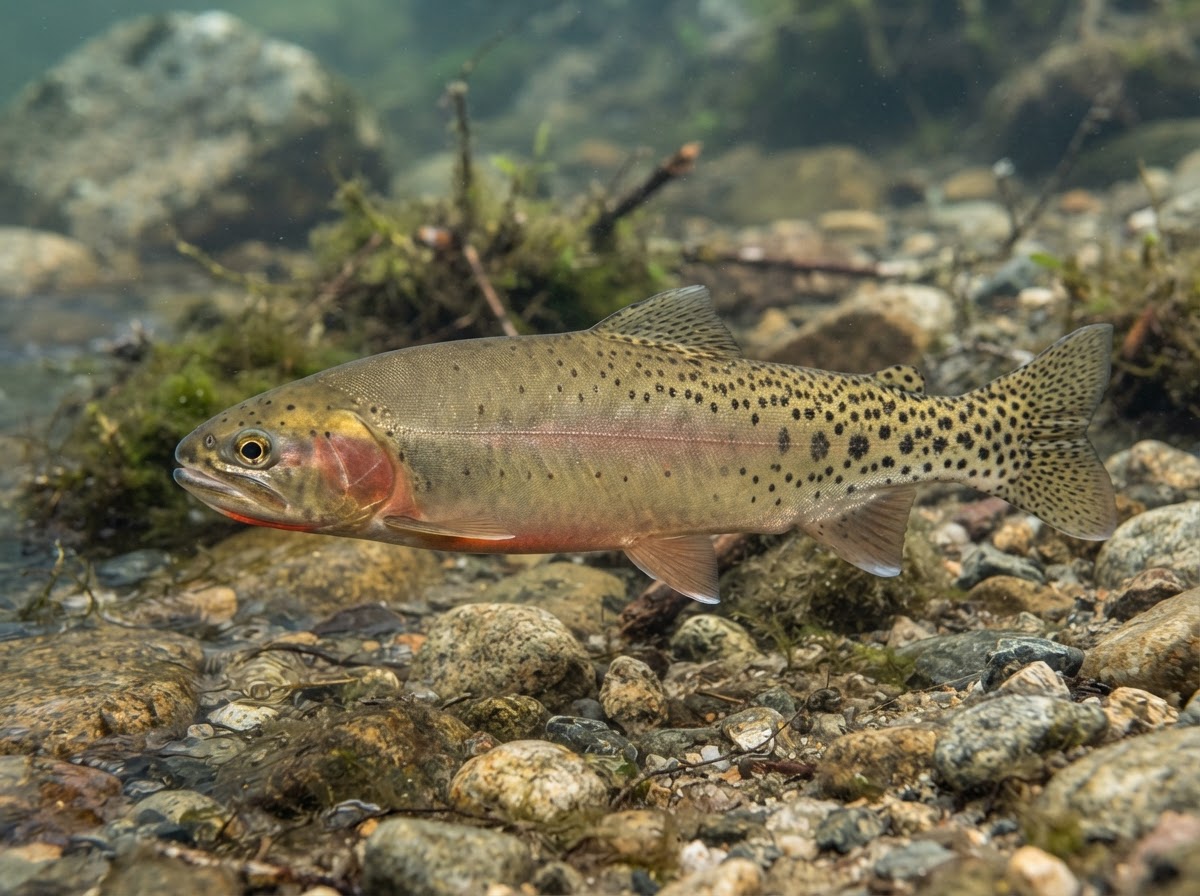
Depending on the population, Cutthroat Trout may appear: olive, golden, bronze, yellowish, gray or relatively silvery. Resident mountain-stream fish can look very different from larger lake-dwelling or coastal forms.
Dark spotting is common, but spot density and placement vary strongly among subspecies. Some Cutthroat populations show dense spotting toward the tail. Others have relatively sparse spotting across much of the body.
That variation is one reason spot pattern can help identify a particular subspecies but should not be used as a single universal Cutthroat rule.
Look beneath the lower jaw for the characteristic: red-to-orange linear marksthat give the fish its common name.
This can become complicated because the two species are closely related and can hybridize. A typical Rainbow Trout is more likely to show: a pronounced pink or reddish lateral stripe dense black spotting no strong paired throat slash.
A Cutthroat more typically shows: the characteristic lower-jaw slash coloration and spotting associated with its particular subspecies less of the classic Rainbow lateral stripe Hybrids
Cutthroat Trout and Rainbow Trout can produce hybrids commonly called cutbows. Hybridization can blur the identification traits anglers expect to see.
If a fish appears to combine strong Rainbow and Cutthroat characteristics, visual identification alone may not provide absolute certainty.
Cutthroat Trout are native to western North America. Their natural distribution spans a remarkable range of environments, from Pacific coastal watersheds to inland mountain streams, high-elevation lakes and major interior drainage systems.
Different Cutthroat Trout subspecies evolved within different geographic regions and watersheds.
Well-known forms include fish associated with:
and other distinct western systems. The species occurs naturally across portions of: the western United States, western Canada, and coastal Alaska. Cutthroat Trout have also been introduced outside portions of their native range.
“Cutthroat Trout” is one species, but the species contains numerous distinctive regional forms. That means a Cutthroat Trout in a coastal stream can represent a very different ecological story from one living in a high-elevation Rocky Mountain creek.
The national Species page should explain that diversity. Individual State and Water pages should later own the local fishery.
Cutthroat Trout occupy a wide variety of coldwater habitats across western North America.
Depending on the subspecies and life history, they may live in:
Their common requirement is suitable cold, clean, oxygenated water, but the exact habitat changes dramatically across the species' range.
In flowing water, Cutthroat Trout commonly use:
They often hold where current delivers food without requiring constant high-energy swimming.
In some western watersheds, native Cutthroat populations survive primarily in colder upper tributaries.
These small streams can function as important refuges where competition or hybridization with introduced trout is reduced.
Lake-dwelling Cutthroat may use: shorelines, drop-offs, tributary mouths, open water, and deeper thermal habitat, depending on season and forage.
Coastal Cutthroat can use freshwater, estuarine and nearshore environments during different parts of their lives.
That life history makes them very different from a Cutthroat living its entire life in a mountain stream.
Cutthroat Trout behavior changes substantially with habitat, subspecies and life history.
In streams, fish often behave much like other current-oriented trout: they occupy positions where food is delivered efficiently while nearby depth or structure provides protection.
In less pressured backcountry water, Cutthroat can sometimes appear unusually willing to rise or investigate a fly. That reputation has led anglers to describe Cutthroat Trout as “easy.” That is an oversimplification. A lightly pressured mountain fish and a heavily pressured Cutthroat in clear technical water can behave very differently.
Cutthroat are opportunistic feeders. They may focus on: drifting aquatic insects, surface insects, terrestrials, crustaceans, or fish prey depending on the water.
Some populations remain within relatively small stream systems. Others migrate substantial distances between: tributaries, rivers, lakes, or coastal feeding habitat.
Cutthroat populations are often closely tied to specific native watersheds. Movement barriers, habitat fragmentation and interactions with non-native trout can therefore have major effects on individual populations.
For anglers, understanding which Cutthroat population you're fishing for can matter almost as much as understanding the species generally.
Many Cutthroat populations become increasingly active as water temperatures rise and aquatic insects become more available. Spring is also closely tied to spawning for many populations. Fish may move from lakes or larger rivers toward tributaries and suitable spawning habitat. High flows and runoff can strongly influence fish position in mountain systems.
Summer can produce excellent Cutthroat fishing where water remains cold. Aquatic insects and terrestrials may both become important food sources. In smaller western streams, grasshoppers, beetles and ants can create significant surface-feeding opportunities. As water warms, fish may increasingly rely on: cold tributaries, deeper pools, higher-elevation habitat, or other thermal refuge.
Cooling water can expand suitable habitat and alter feeding behavior. Fish may continue feeding heavily in preparation for winter. Depending on the water, aquatic insects, terrestrials and larger prey can all remain important.
In colder climates, metabolism and feeding generally slow. Stream Cutthroat often favor deeper or slower water that reduces energy expenditure.Lake populations may use deeper winter habitat, while some waters support ice-fishing opportunities where regulations and fishery conditions allow. The exact seasonal story depends heavily on: subspecies + elevation + watershed + life history.
spawning
Featured

Get trout fishing knowledge, hatch intel, gear picks and updates from Trout Eddy — sent when there’s something worth sending.




