
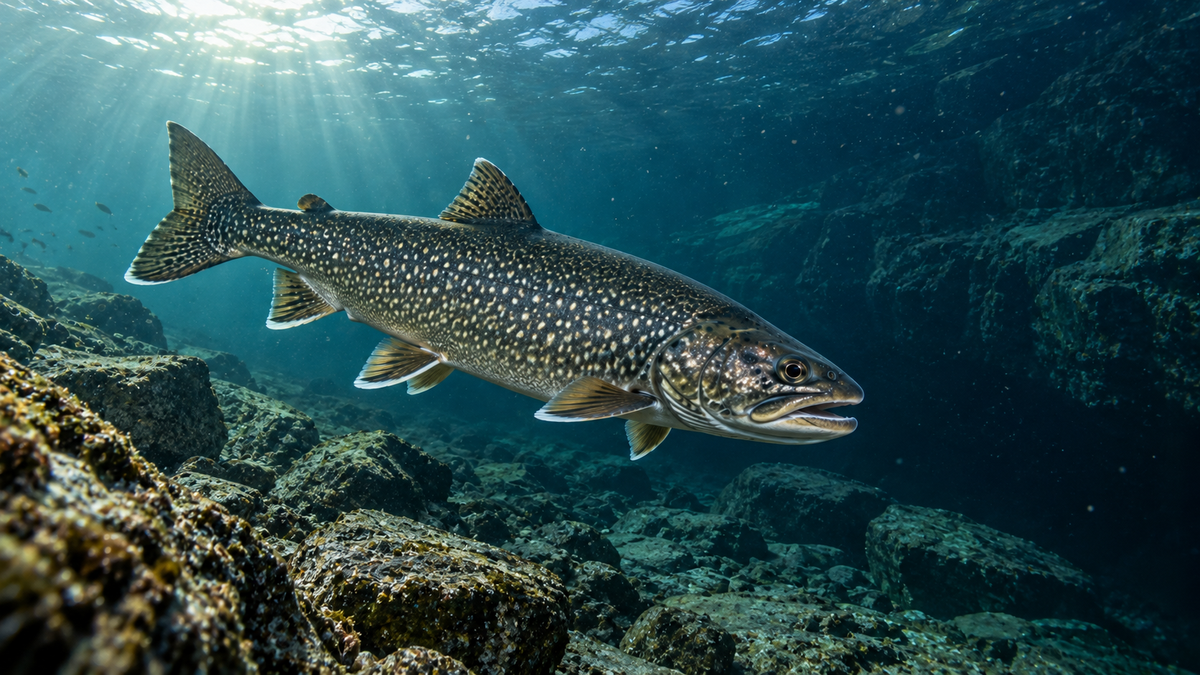
Michigan lake trout fishing becomes much easier to understand once you stop thinking of lake trout as fish that simply “live deep.”
Lake trout are coldwater predators. Where that cold water occurs changes through the year. So does the depth of the fish. Michigan DNR notes that lake trout may occupy relatively shallow water during fall, winter and spring, then move much deeper as nearshore water warms during summer.
That gives Michigan lake trout anglers a better starting framework than memorizing one depth or one lure:
In other words: don’t start by asking how deep lake trout live. Start by asking where suitable lake-trout habitat and food should overlap on this water right now.


In other words: don’t start by asking how deep lake trout live. Start by asking where suitable lake-trout habitat and food should overlap on this water right now.
At a Glance
Michigan Lake Trout at a Glance
Lake trout depth is not a fixed number. It is the result of habitat, season, water temperature, structure and food.
Native Status
Are Lake Trout Native to Michigan?
Yes. Lake trout, Salvelinus namaycush, are native coldwater fish of the Great Lakes region — that separates their Michigan story from introduced salmonids such as brown trout and rainbow trout. Lake trout historically occupied an important ecological role as a native predator in the Great Lakes. Their Great Lakes populations were severely reduced during the twentieth century by a combination of pressures that included intensive fishing and invasive sea lamprey. Modern lake-trout management has involved decades of rehabilitation, sea-lamprey control, monitoring, stocking and efforts to restore sustainable populations.
This guide owns a different question than a full species profile: where and how should an angler approach lake trout fishing in Michigan?
Where to Find Them
Where Are Lake Trout Found in Michigan?
Michigan DNR says lake trout occur in all five Great Lakes and in many large, deep, coldwater inland lakes. For Michigan anglers, that creates two major fishing situations.
01. Great Lakes Lake Trout
Michigan anglers pursue lake trout in Lake Michigan, Lake Superior and Lake Huron (Lake Erie also holds lake trout, but Michigan’s story is particularly tied to the colder, deeper Great Lakes waters surrounding the state). These are enormous fisheries.
temperature + depth + bottom structure + forage + seasonal movement
02. Inland-Lake Trout
Michigan also has lake trout in suitable large, deep, coldwater inland lakes. Smaller geographically, but the same fundamental problem: where does cold, oxygenated habitat intersect with structure and food? The answer can change dramatically between spring and summer.
cold water + structure + forage
The Lake Trout Location Problem
A lake trout angler has one enormous disadvantage compared with a stream trout angler: the water doesn’t organize itself into obvious current seams. A large lake may give you miles of water, so lake trout fishing requires a different way of reducing the problem. Start with five variables: water (which lake — Lake Michigan is not Lake Superior, and Lake Superior is not an inland lake), season (where fish can comfortably feed in April may be very different from August), temperature and depth (depth is often the mechanism that gets fish to cold water, but cold, suitable habitat is the actual requirement), structure and forage (reefs, points, drop-offs, humps, bottom transitions and baitfish), and only then presentation.
Lake Trout in Lake Michigan
Lake Michigan lake trout represent one of Michigan’s most important lake-trout fishing opportunities, but “Lake Michigan lake trout fishing” is still too broad to tell you where to drop a lure. Lake Michigan is divided into lake-trout management units, and conditions vary substantially along Michigan’s shoreline. In spring, cold water allows lake trout to use shallower portions of the lake — nearshore structure, reefs, points, breaks and bottom transitions. The mistake is assuming “spring = 20 feet.” The useful principle is that cold water expands the amount of shallow habitat available, not that it fixes a number. In summer, as upper and nearshore water warms, lake trout generally move toward deeper coldwater habitat, and electronics, bathymetry, controlled-depth trolling, vertical jigging and precise boat positioning become increasingly useful. Even in summer, one hundred feet of empty water is still empty water — look for the overlap of cold water, structure and forage.
Lake Superior Lake Trout
Lake Superior is another major Michigan lake-trout fishery, with its own management units, structure, forage relationships, ports, reefs, seasonal patterns and regulations — it should not be reduced to “Lake Michigan, only colder.” Michigan’s 2026 regulations even distinguish special areas such as Stannard Rock and Big Reef, where possession limits differ from surrounding Lake Superior management units. Great Lakes lake trout fishing is managed spatially because the fishery itself varies spatially.
Lake Huron Lake Trout
Lake Huron also supports an important Michigan lake-trout fishery. DNR specifically promotes spring lake-trout fishing on Lake Huron, noting that very cold nearshore water can bring fish into relatively shallow areas. But Lake Huron also demonstrates why anglers cannot rely on one statewide “lake trout season” answer — under Michigan’s 2026 regulations, lake-trout possession seasons differ among Lake Huron management units, with some running January through September and others open to possession all year. “Can I fish Lake Huron for lake trout?” and “can I legally keep a lake trout here today?” are not automatically the same question.
Michigan Inland Lake Trout Fishing
Michigan lake trout are not restricted to the Great Lakes — DNR identifies the species in many large, deep, coldwater inland lakes. These fisheries create a more compact version of the same location problem: where is suitable coldwater habitat, how deep is it right now, what structure intersects that habitat, where is the forage, and what presentation can efficiently reach the fish? In spring and other coldwater periods, lake trout may be accessible shallower; as the lake warms, deeper coldwater habitat becomes increasingly important. Before fishing any inland lake, use current Michigan DNR resources to confirm lake trout are currently present and check the applicable season, possession rules, size restrictions, access and any special regulations. Michigan DNR’s Trout Trails tool is useful for identifying biologist-verified trout waters.
Depth
How Deep Are Michigan Lake Trout?
There is no single correct depth — that’s one of the most important things to understand about lake trout. Michigan DNR describes lake trout using water roughly 10 to 30 feet deep during fall, winter and spring, then moving to depths of 100 to 200 feet or more as nearshore waters warm during summer. Those numbers are useful for understanding the scale of seasonal movement. They are not GPS coordinates.
Don’t Oversimplify
Do not turn these figures into “spring = 20 feet, summer = 150 feet” — actual fish position depends on the lake, season, water temperature, weather, forage, structure and local conditions. Use depth as a search variable, not a guarantee.
A better question than “where are lake trout in June?” is: where is suitable coldwater habitat intersecting productive structure and forage on this lake right now? That question travels with you. The calendar doesn’t.
By Season
How Michigan Lake Trout Fishing Changes Through the Year
Spring
Cold water allows fish to occupy shallower zones than they may use later in the year — nearshore structure, reefs, breaks, points and shallower bottom features are worth investigating. This doesn’t mean every lake trout moves shallow; it means cold water makes shallow habitat more available. Search where suitable habitat and forage overlap.
Summer
Summer often pushes the search deeper as nearshore and upper water warms. Electronics and depth control become increasingly important. Anglers may encounter fish near deep structure, along breaks, around reefs, near bottom, or suspended around forage — the key word is may. Don’t assume every lake trout is glued to bottom just because you’re fishing deep.
Fall
Lake trout are fall spawners. DNR describes spawning fish using shoals and shallow reefs, depositing eggs among cobble and gravel after dark. That biological movement can change fish distribution and deserves respect — avoid treating concentrated spawning fish as simply an easier pile of targets.
Winter
Where legal and where ice conditions permit safe access, inland lake trout can also be targeted through the ice. The same principles remain relevant: temperature + structure + forage + depth. Winter does not erase the need to locate fish — it changes how anglers access and present to them. Never assume Great Lakes ice or inland-lake ice is safe based on calendar date, appearance or another angler’s report.
Method
How to Catch Lake Trout in Michigan
The right method depends heavily on fish depth, lake size, structure, season, and whether fish are concentrated or scattered. Three approaches deserve particular attention.
Trolling
Trolling is one of the most important methods for covering large lake-trout water — it lets anglers search horizontally, control depth, cover breaks and contours, and adjust to scattered fish. But trolling should not become “drive around and change spoon colors until something happens.” A better sequence is:
First ask whether the boat is passing through fish, then whether the lure is reaching them correctly. A lure that looks perfect in the boat does nothing if it passes 40 feet above inactive fish.
Jigging
Vertical jigging can be highly effective when lake trout are sufficiently concentrated and anglers can position above them, turning the problem vertical: find → position → drop → control → adjust. If fish are marked at a particular depth, put the presentation into that zone rather than dragging a lure through acres of unproductive water. Jigging becomes much less efficient if you haven’t solved the location problem first.
Ice Fishing
On suitable inland waters, ice fishing can create another way to reach lake trout. Don’t simply drill a hole over “deep water” — use bathymetry, structure, known coldwater habitat, forage clues and electronics where available to narrow the search. Ice safety always outranks fishing.
What do Michigan lake trout eat? The useful concept for Michigan fishing is that lake trout location and forage location are connected — structure alone isn’t enough. A beautiful reef with no feeding opportunity may be less productive than a less obvious area holding forage. And don’t assume every fish is sitting on bottom: lake trout can also use the water column when forage or conditions make that profitable, so when using sonar, look for bait, suspended marks, and fish above structure, not only the bottom.
Eddy Says
“What color spoon are they hitting?”
You’re trolling 60 feet over the fish, Gary. I don’t think chartreuse is the emergency here.
What Is the Michigan Lake Trout Limit?
There is not one Michigan lake-trout limit that accurately describes every Michigan fishery. Great Lakes lake-trout regulations vary by Great Lake, management unit, possession season, size restriction, daily possession limit, and special refuge or reduced-limit area.
| Lake & Unit | Possession Season | Min. Size | Daily Limit |
|---|---|---|---|
| Lake Michigan MM 1–5 | Jan. 1–Sep. 30 | 15 in. | 2 (combined) |
| Lake Michigan MM 6–8 | Open all year | 15 in. | 3 (combined) |
| Lake Superior, most units | Open all year | 15 in. | Varies by unit |
| Lake Superior — Stannard Rock & Big Reef | Open all year | 15 in. | 1 (combined) |
| Lake Huron MH 1–2 | Jan. 1–Sep. 30 | 15 in. | 3 (combined) |
| Lake Huron MH 3–6 | Open all year | 15 in. | 3 (combined) |
Lake Michigan MM 1–5 covers Menominee, Escanaba, Manistique, Harbor Springs, Charlevoix, Traverse City, Leland, Frankfort and Platte Bay; MM 6–8 covers Arcadia, Manistee, Ludington, Grand Haven, Holland and New Buffalo. Limits shown are combined lake trout/splake daily possession limits. These numbers are highly volatile — always verify against the current Michigan DNR regulation tables before fishing.
Lake Trout Refuges Matter
Refuge Closure
Michigan’s Great Lakes regulations identify specific lake-trout refuges. These are not merely areas with a smaller possession limit — DNR states that designated lake-trout refuges are closed to taking, keeping and sportfishing for lake trout. If you’re planning a Great Lakes trip, identify the management unit and any refuge boundaries before fishing, not after a fish is in the boat.
Regulations
Michigan Lake Trout Fishing Regulations
Trout Eddy is not the legal authority for Michigan fishing regulations. Use the current Michigan DNR Fishing Regulations, in effect through March 31, 2027. For Great Lakes lake trout, use the current Lake Trout Management Unit map and the Lake Trout & Splake regulation tables. For inland trout lakes, use Michigan DNR’s Inland Trout and Salmon Regulations Map. For broader season context, see Michigan Trout Season. Remember: fishing season, possession season and legal harvest are related, but not always identical questions.
Michigan’s state-record lake trout weighed 61 pounds, 8 ounces. That number is impressive — it is not a useful fishing strategy. Trophy fishing still begins with the same problem as ordinary lake-trout fishing: find suitable habitat and feeding opportunity.
Decision Framework
Michigan Lake Trout Decision Framework
When you arrive at the lake, use this sequence.
1. Identify the Water
Lake Michigan → Lake Superior → Lake Huron → inland lake. The lake changes the scale, management and fishing problem.
2. Identify the Seasonal Habitat
Is cold water available shallow, or has warming pushed the usable zone deeper?
3. Narrow the Depth Range
Use season, temperature information, bathymetry, previous fishery knowledge and electronics to eliminate unlikely water.
4. Find Structure and Forage
Look for the overlap between suitable habitat and feeding opportunity.
5. Locate Actual Fish
Use observations and electronics rather than assuming every good-looking spot contains lake trout.
6. Choose the Presentation
Trolling, vertical jigging, ice presentation on applicable inland waters, or another legal method suited to the fishery.
7. Troubleshoot in Order
Location → depth → boat / lure control → presentation → offering. Buying another spoon will not fix fishing the wrong depth in the wrong part of the lake.
A stream trout angler can look at the surface and often see much of the structure controlling the fishery. A lake-trout angler may be floating over 150 feet of water with the target completely invisible. That’s why lake trout fishing rewards anglers who learn to eliminate water: find the right lake, the seasonal habitat, the depth, the structure and food, the fish — then put something in front of them.
