
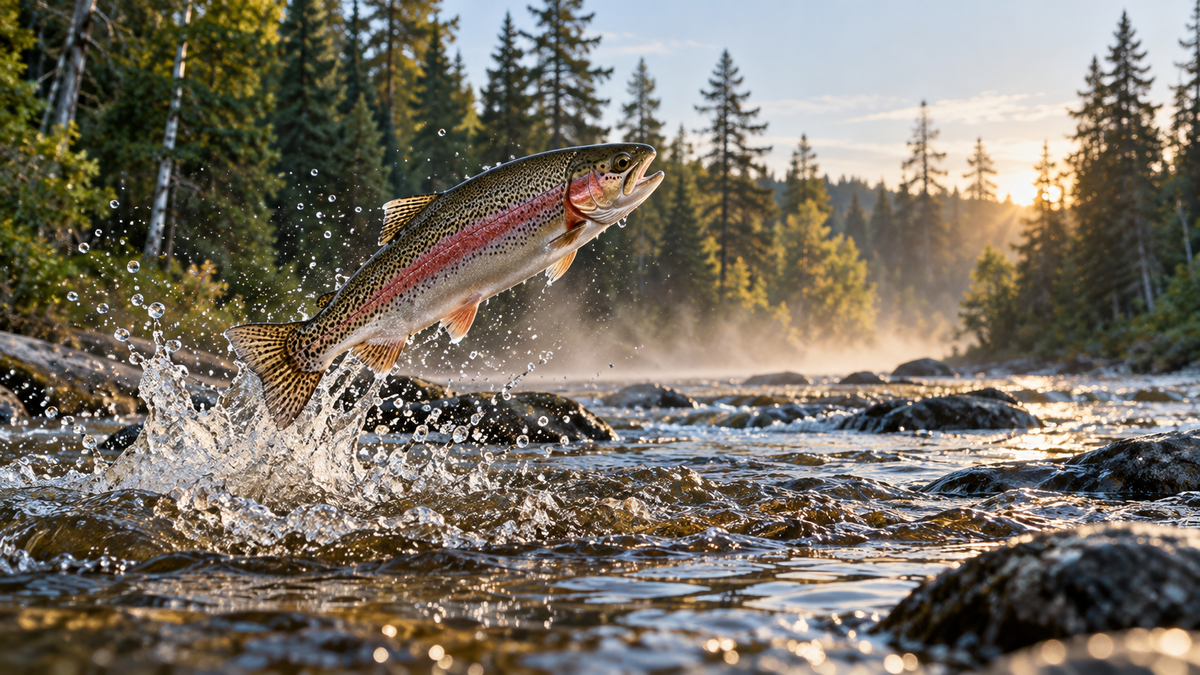
Michigan rainbow trout fishing starts with an important distinction: not every rainbow trout in Michigan lives the same kind of life.
Some remain in inland streams. Others live in Michigan’s coldwater lakes. And rainbow trout that grow in the Great Lakes and migrate into tributaries are commonly called steelhead. Same species. Different life history. Different fishing problem.
That gives Michigan anglers a more useful way to think about rainbow trout:
Life History → Water Type → Season → Fish Position → Presentation
A rainbow trout holding in a northern Michigan lake is not the same fishing problem as one feeding in a river. And neither should be approached exactly like a Lake Michigan steelhead entering a tributary in November. Start by identifying which rainbow-trout fishery you’re actually fishing.
At a Glance
Michigan Rainbow Trout at a Glance
- Rainbow trout are not native to Michigan.
- Michigan DNR says rainbow-trout eggs were imported from California in 1876.
- The first Michigan stocking occurred in the Au Sable River.
- Rainbow trout are now found across the state.
- Michigan supports resident stream rainbows and inland-lake rainbow trout fisheries.
- DNR identifies rainbow trout in both northern and southern Michigan lakes.
- Great Lakes rainbow trout that migrate into rivers are commonly called steelhead.
- Stream rainbows can be caught with flies, artificial lures and bait where legal; lake rainbows may be targeted by trolling, bait fishing and winter jigging where conditions and regulations allow.
- Regulations vary by water classification and individual fishery.
Rainbow trout describes the species. Resident rainbow and steelhead describe different life-history expressions of that species.
Native Status
Are Rainbow Trout Native to Michigan?
No. Rainbow trout, Oncorhynchus mykiss, are native to the Pacific watershed of North America. Michigan DNR says rainbow-trout eggs were imported from California in 1876. The first Michigan stocking occurred in the Au Sable River. Four years later, rainbow trout were stocked in the Lake Michigan watershed. Today, DNR says rainbow trout can be found throughout Michigan — deeply established in Michigan fishing history, but not native.
This Michigan guide has a narrower job than a full species profile: where do rainbow trout fit into Michigan fishing, and how should anglers approach the state’s different rainbow-trout fisheries?
Rainbow vs. Steelhead
Rainbow Trout vs. Steelhead in Michigan
This is probably the most important distinction on the page. Rainbow trout and steelhead are the same species. Michigan DNR says they are genetically the same fish but follow different life histories. A resident rainbow trout remains inland. A steelhead grows in the Great Lakes and migrates into tributaries.
That means a search for “rainbow trout in Lake Michigan” often leads directly into the steelhead fishery. If your actual goal is fall, winter or spring Great Lakes tributary fishing, see Michigan Steelhead Fishing — that guide owns steelhead migration, fall runs, winter holding, spring spawning movement, tributary tactics and Great Lakes steelhead presentations.
The practical rule is: if the fish lives primarily in inland water, think resident rainbow. If it grows in the Great Lakes and migrates into tributaries, think steelhead.
Are There Rainbow Trout in Lake Michigan?
Yes — but Michigan anglers normally call the migratory Great Lakes form steelhead. Michigan DNR specifically describes large rainbow trout that inhabit the Great Lakes and move inland into streams to spawn as steelhead. So searches such as “Lake Michigan rainbow trout” or “rainbow trout Lake Michigan fishing” are often describing the same fishery anglers know as Lake Michigan steelhead. A fish moving from Lake Michigan into a tributary should be approached according to migration stage + river conditions + fish position + presentation.
Where to Find Them
Where Are Rainbow Trout Found in Michigan?
Michigan rainbow trout occupy more types of water than many anglers realize. For fishing purposes, divide the state’s rainbow-trout opportunities into three broad situations.
Michigan rainbow trout occupy more types of water than many anglers realize. For fishing purposes, divide the state’s rainbow-trout opportunities into three broad situations.
01 Resident Stream Rainbow
Current Michigan DNR Better Fishing Waters data identifies rainbow-trout opportunities in waters such as the Rapid River, Pine River, sections of the Manistee River, Bark River, Days River, Eighteen Mile Creek, Fishdam River, Sturgeon River, Huron River and Paint Creek. These examples show resident rainbows occur across different parts of the state, not that these are the only waters.
current + cover + depth + food
02Inland-Lake Rainbow
Michigan DNR says rainbow trout are strongly associated with clear-water northern Michigan lakes but have also been stocked successfully in southern Michigan waters, including Elk Lake, Higgins Lake, Burt Lake, Mullett Lake and dozens of other lakes statewide. These are examples, not a complete inventory.
temperature + depth + structure + forage
03Great Lakes / Steelhead
Rainbow trout that grow in the Great Lakes and migrate into streams are Michigan steelhead. This creates a third fishery with its own seasonal movement, tributary behavior and presentation system. Do not mix all three fisheries into one set of tactics.
migration stage + flow + holding water + presentation
Same species. Three different fishing systems.
Northern Michigan is strongly associated with rainbow trout because the region contains both coldwater streams and clear inland lakes capable of supporting them. DNR’s current fishery data identifies rainbow trout across northern Lower Peninsula and Upper Peninsula waters, from small streams to large inland lakes. So “rainbow trout fishing in northern Michigan” is still too broad to choose a technique — first ask: stream or lake?
In moving water, look for feeding lanes, seams, riffle-run transitions, deeper pockets, pools, cover and current edges. In lakes, the problem shifts toward temperature, depth, structure, forage, time of day and seasonal movement — which may call for trolling, bait fishing or other legal lake presentations rather than river-style fly fishing.
By Season
How Michigan Rainbow Trout Fishing Changes Through the Year
Season matters because water temperature, food availability and fish position change — but the effect depends on the fishery.
Spring
Spring can create strong rainbow-trout opportunities in both streams and lakes: cold water, changing flows, aquatic-insect activity and increasing trout feeding in streams; in lakes, cooler water can leave more of the water column usable than during summer. Spring expands possibilities — it doesn’t eliminate the need to locate fish.
Summer
Summer separates stream and lake tactics more clearly. In streams, pay attention to water temperature, shade, depth, current, feeding windows, insect activity and available cover — warm-water stress becomes increasingly important. In lakes, as surface water warms, rainbow trout may increasingly use deeper or more thermally suitable water. DNR specifically notes a fishing technique involving rainbows near the thermocline — the zone where water temperature changes sharply with depth. In a lake, the best-looking shoreline is not necessarily where the trout are.
Fall
Cooling water can change both stream and lake rainbow-trout behavior. Resident fish may redistribute as temperatures and food availability change. Steelhead create a completely separate fall migration story in Great Lakes tributaries — see Michigan Steelhead Fishing. Don’t let “rainbow trout” erase the distinction between resident trout and migratory fish.
Winter
Michigan has legal winter rainbow-trout opportunities in some waters. DNR specifically notes that anglers may jig for rainbow trout through the ice in large lakes, but legal season depends on the individual water and its regulation classification. For statewide season structure, see Michigan Trout Season.
Method
How to Catch Rainbow Trout in Michigan
In Streams
Michigan DNR explicitly lists live bait, artificial lures and flies where legal — but method comes after fish position. Start by reading the water. Rainbow trout often benefit from holding where current brings food without forcing them to expend unnecessary energy: look for seams, current edges, riffle transitions, pool heads, pockets behind structure, deeper lanes and areas where food concentrates.
For fly fishing, the useful sequence is:
Fish Position → Food Stage → Depth → Presentation → Fly
Not fly → flip through box until something happens. Use dry flies when visible rises, emerging insects or consistent feeding lanes tell you the surface matters. Use nymphs when trout are feeding below the surface, where position, depth, drift, strike detection and fly profile are the important variables. Use a streamer when the water, fish position and forage make a moving-food presentation logical — not because “rainbows are aggressive.”
In Lakes
Lake rainbows require a different mental model — there is no current seam organizing the water for you. Ask: where does suitable temperature overlap with feeding opportunity? DNR identifies trolling as a productive method for covering water, controlling depth and searching feeding zones in larger lakes; bait fishing is also legitimate where legal. Around the thermocline, don’t ask only how deep the lake is — ask where the thermally useful feeding zone is. Through the ice, DNR also notes rainbow trout can be caught by jigging in winter: depth → structure/temperature → fish → presentation. Drilling a hole does not create trout beneath it.
Eddy Says
“Rainbow trout or steelhead?”
Same fish. Completely different Tuesday. Figure out where he lives before you start changing flies.
Regulations
Michigan Rainbow Trout Fishing Regulations
Do not use this article as your legal authority. Rainbow-trout regulations depend on the water. Michigan’s inland trout and salmon waters use classifications that can affect fishing season, possession season, minimum size, daily possession limit and tackle.
Special Rule
Current regulations identify portions of the Muskegon River where daily possession rules include special rainbow-trout limits and a maximum number of larger rainbows. That is exactly why a generic “Michigan rainbow trout limit is X” answer is unsafe.
For current regulations: Michigan DNR Fishing Regulations at michigan.gov/dnr/things-to-do/fishing/fishing-regulations. For inland trout waters, use Michigan DNR’s Inland Trout and Salmon Regulations Map. The 2026 Michigan Fishing Regulations are in effect through March 31, 2027.
Lake Michigan rainbow trout. If you’re fishing Lake Michigan for rainbow trout, remember the Great Lakes fishery is generally discussed as steelhead. Michigan’s 2026 Great Lakes trout and salmon table includes Rainbow Trout (Steelhead). The broad Great Lakes season is open all year on Lake Michigan and Michigan’s other listed Great Lakes waters, but anglers still need to check minimum size, daily possession limit, species-combination rules, tributary rules and special water-specific regulations. A legal Great Lakes rule does not automatically carry into every tributary.
Decision Framework
Michigan Rainbow Trout Decision Framework
Use this sequence before choosing a fly or lure.
1. Identify the Life History
Is this fish a resident rainbow or a Great Lakes steelhead? If steelhead, go to Michigan Steelhead Fishing.
2. Identify the Water Type
Stream → inland lake → Great Lakes/tributary.
3. Identify the Seasonal Situation
Water temperature, flow, lake stratification, insect activity, forage, migration.
4. Predict Fish Position
Streams: current + depth + structure + food. Lakes: temperature + depth + structure + forage. Steelhead: migration stage + river conditions + holding/travel water.
5. Choose the Presentation
Dry fly, nymph, streamer, spinner, bait where legal, trolling, ice-jigging, or another legal method suited to the fishery.
6. Troubleshoot in Order
If you’re not catching fish: life history → position → depth/zone → presentation → offering. Don’t start at the end.
Use this sequence before choosing a fly or lure.
The species name alone doesn’t tell you how to fish. Michigan rainbow trout fishing is unusual because one species supports several very different fisheries — resident rainbows in moving water, rainbows in deep northern lakes, stocked rainbows in southern Michigan lakes, and the Great Lakes migratory fish anglers call steelhead. Which rainbow trout are you actually fishing for? Answer that first, then identify the water, read the conditions, find the fish, and finally choose the presentation.
