
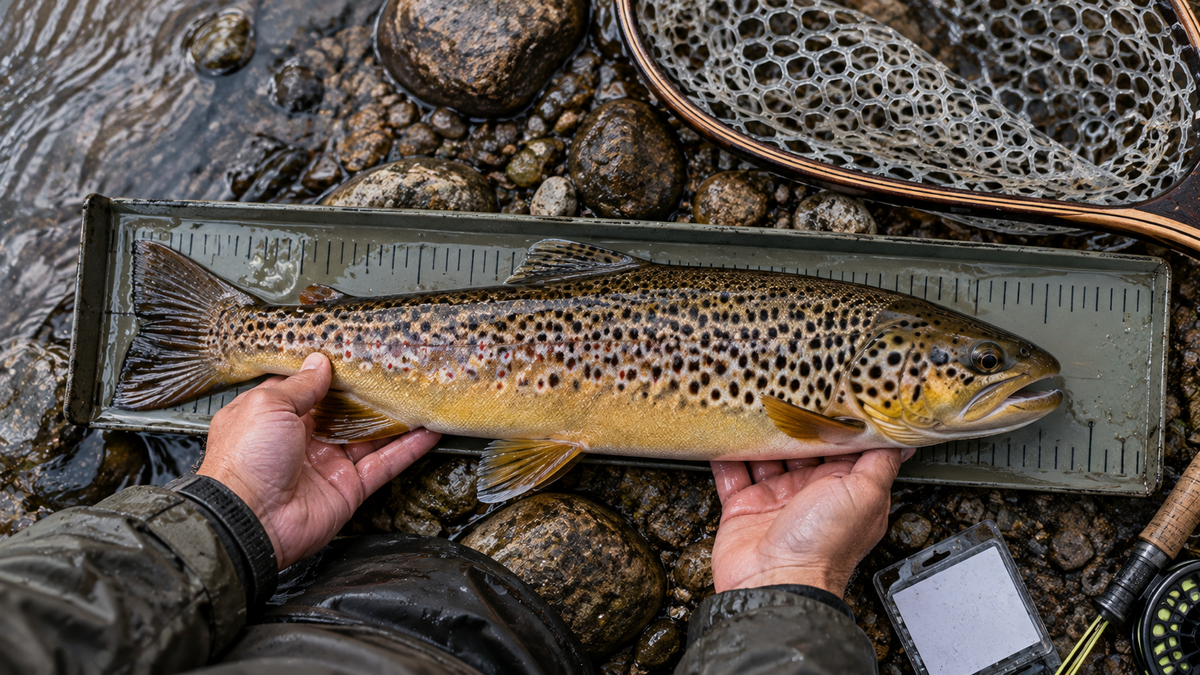
Michigan trout regulations make a lot more sense once you stop looking for one statewide trout limit.
There isn't one.
The legal rule can change based on:
- the exact river, stream or lake
- whether it is inland or Great Lakes water
- the water's regulation Type
- whether it is Gear Restricted
- whether it is a Brook Trout Restoration Area
- the trout or salmon species
- fishing season
- possession season
- minimum size
- daily possession limit
- tackle restrictions
- water-specific exceptions
So the safest way to read Michigan fishing regulations is:
WATER → REGULATION SYSTEM → SEASON → SPECIES → SIZE / POSSESSION → TACKLE → EXCEPTIONS
Do not start with:
“What's the Michigan trout limit?”
Start with:
“What exact water am I fishing?”
For the broader Michigan trout fishery:
Michigan's 2026 Fishing Regulations are in effect through March 31, 2027.
Official source:
https://www.michigan.gov/dnr/things-to-do/fishing/fishing-regulations
Michigan Trout Regulations at a Glance
Michigan trout rules fall into several major systems.
| Water / regulation system | What controls the rule | What anglers must check |
|---|---|---|
| Inland Type 1–4 streams | Statewide stream-Type table plus county/water exceptions | Season, possession season, size, daily limit |
| Gear Restricted Streams | Water-specific gear-restricted table | Season, possession, flies/artificial-lure rule, size, limit |
| Brook Trout Restoration Areas | BTRA rules | Brook/Lake/Splake size and possession restrictions |
| Inland Type A–F lakes | Statewide lake-Type table plus exceptions | Season, tackle, size, daily limit |
| Unclassified inland waters | General inland rule unless an exception applies | Season, size, possession, county exceptions |
| Great Lakes and connecting waters | Great Lakes trout/salmon table | Species combination limits, minimum size, special notes |
| Great Lakes lake trout / splake | Management-unit tables and maps | Unit, possession season, size, daily limit, refuge |
| Individual special waters | County listings / Fisheries Orders | Any rule overriding the general table |
The important point is:
the statewide table is only the beginning.
Michigan DNR specifically instructs anglers to use the Inland Trout and Salmon Regulations Map together with the current Fishing Regulations.
Step 1: Identify the Exact Water
This is the most important step.
You need to know whether you're fishing:
- a named inland stream
- an inland lake
- a Gear Restricted Stream
- a Brook Trout Restoration Area
- a Great Lake
- a Great Lakes connecting water
- a drowned river mouth lake
- another water with a special regulation
The legal rule comes from the water.
Not from the trout species alone.
Use Michigan DNR's current map:
https://www.michigan.gov/dnr/things-to-do/fishing/maps
The map identifies:
- Type 1 streams
- Type 2 streams
- Type 3 streams
- Type 4 streams
- Gear Restricted Streams
- Brook Trout Restoration Areas
- Type A–F inland lakes
Step 2: Determine the Regulation Type
Michigan's inland trout system organizes many waters by Type.
For streams, those are:
Type 1
Type 2
Type 3
Type 4
For regulated inland trout lakes:
Type A through Type F
Those classifications affect:
- season
- minimum size
- possession
- sometimes tackle
But special water-specific rules can override the general Type table.
That is why the Type is a starting point rather than the final answer.
Michigan Inland Trout Stream Regulations
Under the 2026 Michigan Fishing Regulations, the statewide Type 1–4 stream framework is:
| Stream Type | Fishing season | Possession season | Brook Trout minimum | Brown Trout minimum | Rainbow / Lake Trout / salmon / Splake minimum | Daily trout & salmon limit |
|---|---|---|---|---|---|---|
| Type 1 | Last Saturday in April–Sept. 30 | Same | 7" | 8" | 10" | 5 fish, no more than 3 trout 15" or greater |
| Type 2 | Last Saturday in April–Sept. 30 | Same | 10" | 12" | 10" | 5 fish, no more than 3 trout 15" or greater |
| Type 3 | Open all year | Open all year | 15" | 15" | 10" | 5 fish, no more than 3 trout 15" or greater |
| Type 4 | Open all year | Brook Trout, Brown Trout and Atlantic Salmon: last Saturday in April–Sept. 30; other trout/salmon: open all year | 7" | 10" | 10" | 5 fish, no more than 3 trout 15" or greater |
These are the general statewide Type rules.
Michigan DNR explicitly tells anglers to check the county listings for exceptions.
Do not use this table as a substitute for checking the specific water.
Why Type 4 Is Easy to Misread
Type 4 streams are the perfect example of why “open all year” can be misleading.
Under the 2026 rules:
Fishing season: open all year.
But:
Brook Trout, Brown Trout and Atlantic Salmon possession: last Saturday in April through September 30.
Other listed trout and salmon have year-round possession under the general Type 4 table.
So:
legal to fish
does not always mean:
legal to keep every trout species.
This distinction is important enough to check every time you fish a new Type 4 stream.
Michigan Inland Trout Lake Regulations
Michigan's regulated trout lakes use Types A–F.
The 2026 statewide framework is:
| Lake Type | Fishing / possession season | Tackle | General trout daily limit |
|---|---|---|---|
| Type A | Last Saturday in April–Oct. 31 | All except minnows | 5 fish, with no more than 3 trout 15" or greater |
| Type B | Open all year | All | 5 fish, with no more than 3 trout 15" or greater |
| Type C | Open all year | All | 5 fish, with no more than 3 trout 15" or greater |
| Type D | Last Saturday in April–Oct. 31 | Artificial lures only | 1 |
| Type E | Open all year | All | 3 trout and salmon combined; see current species rules |
| Type F | Open all year | All | 5 fish in combination, subject to species-combination rules |
Minimum sizes vary by both lake Type and species.
That is why this page should not reduce Michigan lake regulations to a single size-limit table without context.
The correct sequence remains:
LAKE → TYPE → SPECIES → CURRENT TABLE
Inland Lakes Not Classified by Type
Under the 2026 rules, most inland lakes not classified as Types A–F are generally open all year for trout.
Michigan DNR lists the general rule as:
- 8-inch minimum size
- five-fish daily possession limit
- no more than three fish 15 inches or greater
with exceptions including waters governed under separate systems such as Michigan-Wisconsin Boundary Waters and Sylvania Wilderness Area.
Always check the named water before relying on the general rule.
Inland Streams Not Classified by Type
Most inland streams not classified as Type 1–4 or as Gear Restricted are generally open to trout fishing all year under the current rules.
The general 2026 framework includes:
- 8-inch minimum for most trout
- 7-inch minimum for Brook Trout
- five-fish daily possession limit
- no more than three fish 15 inches or greater
But again, Michigan-Wisconsin Boundary Waters and other special regulations can differ.
Michigan Gear Restricted Streams
Some of Michigan's most famous trout water does not use the ordinary Type 1–4 tackle rules.
Gear Restricted Streams can be:
Flies Only
or:
Artificial Lures Only
Michigan DNR states that on Gear Restricted Streams it is unlawful to use or possess:
- live bait
- dead or preserved bait
- organic or processed food
on the regulated water or shore.
On Flies Only Gear Restricted Streams, scented material is also prohibited.
These waters can also have completely different:
- possession seasons
- minimum sizes
- daily limits
- catch-and-release rules
So never assume:
“It's a Type 3 river, therefore the normal Type 3 rule applies.”
If the reach is Gear Restricted, read the rule for that exact reach.
Why the Au Sable Is a Good Regulations Example
The Au Sable demonstrates how dramatically rules can change within one river system.
Different reaches of the Mainstream, North Branch and South Branch have current regulations that include combinations of:
- flies only
- artificial lures only
- catch-and-release
- zero-trout possession
- two-trout limits
- 18-inch Brown Trout minimums
- different Brook Trout and Rainbow Trout minimums
That is exactly why Trout Eddy should never publish a statement such as:
“The Au Sable trout limit is two fish.”
Which Au Sable reach?
For full river context:
Then verify the exact reach against Michigan DNR.
Brook Trout Restoration Areas
Michigan's Brook Trout Restoration Areas have more restrictive regulations than the normal statewide stream table.
Under the 2026 BTRA framework:
Brook Trout possession season: last Saturday in April through September 30.
Minimum size: 20 inches for Brook Trout, Lake Trout and Splake.
Daily possession: one Brook Trout, Lake Trout or Splake total combined.
Michigan DNR states that these rules supersede conflicting regulations elsewhere.
If you're fishing water shown as a BTRA on the DNR map, use the BTRA rule first.
Michigan Trout Size Limits
There is no single Michigan trout size limit.
That's not evasive.
It's the actual regulatory structure.
A legal Brook Trout size can differ among:
- Type 1 stream
- Type 2 stream
- Type 3 stream
- Type 4 stream
- Gear Restricted Stream
- BTRA
- Type A–F lake
- unclassified inland lake
- Great Lakes water
The same is true for Brown Trout, Rainbow Trout and Lake Trout.
So when somebody asks:
“What size trout can you keep in Michigan?”
the correct answer is:
Tell me the water first.
Michigan Brook Trout Size Limit
Under the general 2026 inland stream Type rules:
Type 1: 7"
Type 2: 10"
Type 3: 15"
Type 4: 7"
But special water rules and Brook Trout Restoration Areas can supersede those numbers.
For Michigan-specific Brook Trout fishing:
Michigan Brown Trout Size Limit
Under the general 2026 inland stream Type rules:
Type 1: 8"
Type 2: 12"
Type 3: 15"
Type 4: 10"
Gear Restricted reaches can be much more restrictive.
For example, some Au Sable sections use an 18-inch Brown Trout minimum.
For Michigan-specific Brown Trout fishing:
Michigan Rainbow Trout Size Limit
Under the general 2026 Type 1–4 inland stream framework, Rainbow Trout generally fall under the grouped trout/salmon column with a 10-inch minimum.
But that does not mean every Michigan Rainbow Trout fishery has a universal 10-inch rule.
Water-specific exceptions exist.
Great Lakes Rainbow Trout — steelhead — also operate under a different Great Lakes framework.
For resident Michigan Rainbow Trout:
For the migratory fishery:
Michigan Lake Trout Size Limits
Lake Trout are where a generic Michigan size-limit answer becomes especially dangerous.
Inland regulations vary by lake Type.
Great Lakes Lake Trout and Splake regulations vary by:
- lake
- management unit
- possession season
- minimum size
- daily limit
- refuge
Do not use an inland Lake Trout rule for Lake Michigan.
Do not use a Lake Michigan management-unit rule for Lake Superior.
For the fishing side of the species:
Michigan Fish Limits vs. Trout Limits
The search term michigan fish limits is broader than trout.
This page should not become the complete regulation guide for:
- bass
- walleye
- pike
- muskellunge
- panfish
- sturgeon
- every other Michigan species
Trout Eddy's job here is to explain Michigan trout and salmon regulation structure.
For non-trout species, use the current Michigan DNR Fishing Regulations directly.
Official resource:
https://www.michigan.gov/dnr/things-to-do/fishing/fishing-regulations
Great Lakes Trout and Salmon Regulations
Michigan's Great Lakes trout and salmon rules are separate from the inland Type system.
The 2026 Great Lakes table covers:
- Atlantic Salmon
- Brook Trout
- Brown Trout
- Chinook Salmon
- Coho Salmon
- Lake Trout
- Pink Salmon
- Rainbow Trout / Steelhead
- Splake
The broad listed Great Lakes season is open all year, subject to species-specific notes and Lake Trout/Splake management-unit rules.
The general Great Lakes trout/salmon framework uses:
five total trout and salmon in combination
with:
no more than three of any one species
except the rule allows up to five Coho, Chinook or Pink Salmon.
But several important species have special rules.
Lake Michigan Fishing Regulations
If you're fishing Lake Michigan, do not use the inland trout tables.
Lake Michigan uses the Great Lakes trout-and-salmon framework.
That includes:
- Brown Trout
- Rainbow Trout / Steelhead
- salmon
- Lake Trout
- Splake
- other listed salmonids
Lake Trout and Splake require an additional step because the lake is divided into management units with different regulations.
The legal sequence is:
LAKE MICHIGAN → MANAGEMENT UNIT → SPECIES → CURRENT RULE
For Lake Michigan's complete trout fishery when that Water entity is live:
Lake Michigan Lake Trout Rules
Michigan's 2026 Lake Trout/Splake rules vary between Lake Michigan management units.
That means the legal:
- possession season
- minimum size
- daily possession limit
can change depending on where you're fishing.
This page should not train anglers to memorize one statewide Lake Michigan Lake Trout number.
Use the official Lake Trout Management Unit map and current table.
That's the safer and more durable answer.
Lake Superior Lake Trout Rules
Lake Superior also uses Lake Trout management units.
Michigan changed the rules for Stannard Rock and Big Reef for 2026, reducing the combined Lake Trout/Splake daily possession limit there to one fish.
That's a good example of why a regulation article must be maintained.
Last year's number can become wrong.
Lake Trout Refuges
Michigan's Great Lakes Lake Trout regulations identify designated refuges.
These are not merely low-harvest zones.
Michigan DNR states that Lake Trout refuges are closed to:
- taking Lake Trout
- keeping Lake Trout
- sportfishing for Lake Trout
Check refuge boundaries before fishing.
Fishing Season vs. Possession Season
These terms are not interchangeable.
Fishing season answers:
Can I legally fish this water under this regulation?
Possession season answers:
Can I legally keep this species during this period?
Type 4 streams are the classic example.
Fishing may remain open while possession of Brook Trout and Brown Trout is closed.
That distinction should become automatic whenever you read the Michigan regulations.
Michigan Trout Season vs. Michigan Trout Regulations
These are two separate Trout Eddy pages for a reason.
Michigan Trout Season owns:
- when traditional trout seasons open
- when they close
- which water Types remain open year-round
- how to determine whether a trout fishery is seasonally open
Michigan Trout Regulations owns:
- size
- possession
- tackle
- water classifications
- special restrictions
- Gear Restricted Streams
- Great Lakes regulatory structure
- legal verification process
The pages should support each other.
They should not duplicate each other.
Can You Use Bait for Trout in Michigan?
Sometimes.
On ordinary Type 1–4 streams, Michigan's current regulations allow natural and artificial bait.
But that's not universal.
Examples of restrictions include:
Type A trout lakes: all tackle except minnows.
Type D lakes: artificial lures only.
Gear Restricted Streams: live bait, dead/preserved bait and organic/processed food are prohibited.
Flies Only waters: additional restrictions apply, including the prohibition on scented materials under the current rule.
So before tying on a worm or minnow:
check the water.
What Counts as an Artificial Lure?
Michigan's 2026 regulation update clarified bead fishing for trout and salmon.
A bead used on the hook or pegged/attached to the line no farther than four inches above the eye of a single-pointed hook is defined as an artificial lure.
That clarification matters on waters where artificial-lure rules apply.
For legal definitions, use the current Michigan DNR regulation book.
Is Chumming Legal on Michigan Trout Streams?
Michigan's 2026 inland trout regulations state that chumming is prohibited on:
- Type 1 streams
- Type 2 streams
- Type 3 streams
- Type 4 streams
- Gear Restricted Streams
Do not confuse natural bait being allowed on ordinary Type streams with permission to chum.
Those are different rules.
Do You Need a Michigan Fishing License?
For 2026, anglers age 17 and older generally need a Michigan fishing license to fish public waters.
Michigan's current fishing licenses are valid through March 31, 2027.
License options and fees can change, so Trout Eddy should not make price the evergreen focus of this page.
Use Michigan DNR for current licensing:
https://www.michigan.gov/dnr/things-to-do/fishing
What About Private Property and Access?
Fishing regulations and access rights are different issues.
A river being legally open to fishing does not automatically authorize:
- crossing private property
- parking on private land
- using a private launch
- walking across posted land
- entering closed property
Always verify access separately.
The regulation tells you what fishing rules apply.
It does not give you permission to trespass.
Michigan Fishing Laws vs. the Regulation Summary
Michigan's annual Fishing Regulations booklet is a condensed regulation summary.
Michigan DNR states that the full legal descriptions and regulations are contained in the applicable Fisheries Orders.
That distinction matters if:
- a boundary is unclear
- a management unit is disputed
- a special rule is difficult to interpret
- you need the controlling legal description
Fisheries Orders:
https://www.michigan.gov/dnr/managing-resources/laws/orders/fisheries-orders
For ordinary trip planning, the current regulation summary and maps are usually the practical starting point.
How to Check Any Michigan Trout Regulation
Use this sequence every time you're fishing unfamiliar water.
1. Name the Exact Water
River?
Branch?
Lake?
Great Lake?
Tributary?
2. Open the DNR Regulation Map
https://www.michigan.gov/dnr/things-to-do/fishing/maps
3. Identify the Regulation System
Type 1–4?
Type A–F?
Gear Restricted?
BTRA?
Great Lakes?
Special regulation?
4. Check Fishing Season
Is fishing itself open?
5. Check Possession Season
Can the trout species you're targeting legally be kept?
6. Check Minimum Size
Do not rely on a statewide trout number.
7. Check Daily Possession
Look for both total trout/salmon limits and species-specific restrictions.
8. Check Tackle
Natural bait?
Artificial only?
Flies only?
Other restriction?
9. Check Water-Specific Exceptions
County listings and special sections can override the broad table.
10. Verify Against the Current Regulation Cycle
Never assume last year's rules still apply.
That's the entire Trout Eddy framework:
WATER → REGULATION SYSTEM → SEASON → SPECIES → SIZE / POSSESSION → TACKLE → EXCEPTIONS
The Regulation Rule Worth Remembering
If you remember one thing from this page, make it this:
Michigan does not have one trout limit.
It has a regulatory system tied to the water.
The fish species matters.
The season matters.
The water classification matters.
Special rules matter.
And Great Lakes regulations operate differently from inland trout regulations.
So before you fish:
identify the water
identify the regulation system
check the current DNR rule
Then go fishing.
🐟 EDDY SAYS
“What's the Michigan trout limit?”
Which trout?
Which river?
Which reach?
Which lake?
You gave me a state the size of a mitten and expected one number.
Official Michigan Trout Regulation Resources
Michigan DNR Fishing Regulations
https://www.michigan.gov/dnr/things-to-do/fishing/fishing-regulations
Michigan DNR Inland Trout and Salmon Regulations Map
https://www.michigan.gov/dnr/things-to-do/fishing/maps
Michigan DNR Fisheries Orders
https://www.michigan.gov/dnr/managing-resources/laws/orders/fisheries-orders
These official sources control current legal guidance.
Trout Eddy's job is to help you understand how to use them.
